 |
 ~ Roman Monographs ~ Fountains · part III · Main Fountains PAGE 1 |
 |
|---|
| Part III deals with main fountains. To clear any doubt, the ones listed in these pages are certainly larger than the simple drinking-troughs and the other types described in part II as "small", yet not necessarily huge nor imposing. What distinguishes them is basically the fact of having been created keeping in mind their artistic purpose as much as the practical one. When water had to be drawn from wells and reservoirs, the people may have appreciated their utility more than their look; in fact they used to be called "fountain of..." after the place where they stood, rather than with a name referring to the featured theme. But nowadays a public source of water is no longer a primary need, and the fountains' functionality has been clearly overcome by their pure esthetic value: even when dry (e.g. for maintainance, restoration, or other reasons), the main fountains are still fine monuments to behold. Since small troughs and main fountains alike need water to work, both typologies could only be conceived in Rome after having satisfied two basic conditions: the restoration of the ancient aqueducts, and the making of an underground net of ducts for carrying the water to the different districts. All this began in 1570. |
 detail of the Fountain of the Tortoises |
|---|
 two tritons from the Fountain of the Moor |
For this reason, in the following pages the fountains are listed mainly according to a chronologic ordering, which follows the sequence of the reopening of the ancient aqueducts and, for each of the latter, the various places chosen by the city administration as suitable spots for receiving the new precious resource: running water. Besides actual photographs, also old maps of Rome and engravings are shown, as they illustrate the original urban setting in which the fountains were built (sometimes very different from that of today), and testify the changes in shape and location that many of them underwent through the years. This first page, instead, describes three early ancestors of the fountains we can see today, that were already working before the new net of ducts was laid, and whose shape heavily influenced many others built in the following centuries. |
|---|

other pages
(clickable index)
| page 2 the opening of the Salone water the fountains of piazza del Popolo |
page 3 the fountains of piazza Navona |
page 4 the fountains of piazza Colonna, piazza della Rotonda, piazza San Marco |
|---|---|---|
| page 5 the Fountain of the Tortoises the fountains of Campo de' Fiori |
page 6 the fountains of the Aqua Felix the Fountain of Moses |
page 7 the fountains of piazza del Quirinale and Campo Vaccino |
| page 8 the fountains for Capitolium Hill |
page 9 the semipublic fountains the fountain of piazza dell'Aracoeli |
page 10 the fountains built off the main course of the Aqua Felix |
| page 11 the remaining fountains of the Aqua Felix |
page 12 17th century: the making of the Acqua Paola |
page 13 the fountains in Borgo district |
| page 14 other fountains east of the Tiber |
page 15 fountains supplied by other aqueducts |
page 16 the magnificent Gianlorenzo |
| page 17 the mother of all fountains |
page 18 other fountains of the 18th century |
page 19 the 19th century |
| page 20 the 20th century from 1900 to 1930 |
page 21 the 20th century from 1930 to the present days |
page 22 conclusions |
THE LATE MEDIEVAL FOUNTAINS
(15th CENTURY)
Very few fountains were known to exist prior to the mid 16th century, due to the lack of running water that during the Middle Ages for about 1,000 years represented one of Rome's main problems.
The only aqueduct still partly working was the Aqua Virgo, whose springs were located east of Rome, although it reached the city from the north, due to the duct's winding course. The water flow was much lower than in ancient roman times, as the original channels were damaged, and new springs were used, closer to Rome, yet less abundant and less clean (see also Aqueducts, page 6).
| The aqueduct ended in a central spot, below the Quirinal Hill, by a three-way junction (in Latin trivium), mentioned in old chronicles as Treio, whence the other name "Trevi water" still in use today, although some maintain that this name derived from the location of the original springs, a place once called Trebium. The water gushed out from three individual outlets, each of which had a plain basin, without any particular decoration. Visual records of this early fountain are very scarce; one of them is a painted medallion by Taddeo di Bartolo (c.1410), featuring a simplified map of Rome's monuments and ancient ruins. Few would recognize in this small structure the nucleus of what is today one of Rome's most renowned landmarks, the Fountain of Trevi, described in a further page. |
 the three original basins (arrow) |
|---|
 the fountain, following Nicholas V's alterations |
Only at the end of the Middle Ages pope Nicholas V improved its shape by replacing the three basins with a long rectangular one, also adding a large marble plaque, whose inscription read: pope Nicholas V, after decorating the city with important monuments, in 1453 restored the Aqua Virgo from its old decay. This look remained basically unchanged for over two centuries. In the city's western outskirts stood St.Peter's basilica. The Aqua Traiana, which in ancient times had served this part of Rome, had been restored in the late 8th century, but it had only worked again for 200 years. |
|---|
| The Vatican could still rely on a small amount of water, thanks to a few very early ducts, that had been originally dug by the time of pope Damasus (366-84); they drew water from minor springs, that had been found somewhere below the
nearby Janiculum and Vatican hills. These ducts supplied the main fountain in St.Peter's courtyard (see part I page 2), and probably also two smaller ones, located not very far from the basilica. They had remained in good condition thanks to maintainance works occasionally carried out, especially under two popes: the afore-mentioned Nicholas V (1447-55) and Julius II (1503-13). |
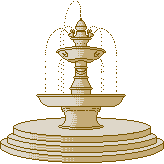 shape of the first fountain by St.Peter's, reconstruction from mid 16th century drawings |
|---|
One of the two working fountains stood in the open place in front of the basilica, today's St.Peter's Square; its elegant shape is known thanks to a few drawings of the 16th century that feature views of the place.
| It consisted of two round basins of different size, collecting the water that gushed from the uppermost element, decorated with four small figures, and resting on a circular base of three steps. According to old documents, it was built around 1490. A decade later, probably among other works for the Jubilee year 1500, pope Alexander VI had nozzles shaped as bull's heads added to the top basin (i.e. the animal featured in the coat of arms of the Borgia family, whom the pope belonged to), but the fountain's shape remained basically the same. |
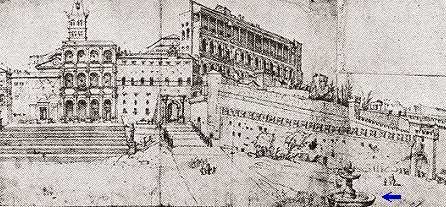 the old St.Peter's basilica (left) and the fountain (arrow), in the mid 1500s |
|---|
An even older one is featured in a map dated 1472 standing by the church of Santa Maria in Trastevere (no fountain appears yet by St.Peter's in this map). Being similar to the previous one, it is likely that the fountain in Trastevere district may have acted as a source of inspiration for the one previously described.
and (right) an enlarged reconstruction of the fountain; in this map, no fountain stood by St.Peter's yet |
Santa Maria's church stands on the same side of the Tiber as St.Peter's, about 1.5 Km or 1 mile further south, thus the fountain was almost certainly connected to the same early ducts that drew
water from the Janiculum's springs. In the map, its lower basin appears square in shape, but this may have been a simplification due to the miniature size of the actual drawing: in fact, many medieval baptismal fonts and wells were octagonal, and this shape was also maintained by several fountains of the 16th century. Furthermore, in 16th century maps it seems to have eight sides. |
|---|


It was built around the mid 1400s, and some scholars suspect that it may have replaced an even older one, whose dating could likely extend far back to the ancient roman days. In fact, the Aqua Alsietina, i.e. the aqueduct that emperor Octavianus had built for his naval stadium in Trastevere (see Curious and Unusual, page 4), very close to this spot, may have easily supplied also a local fountain, although the water it drew was non-drinkable.
| But provided that such old fountain did really exist, it would have been almost dry: the Aqua Alsietina aqueduct had already stopped working in the 4th century, when the surface of the Lake of Martignano, from which the water was drawn (see Aqueducts, part III page 3), rapidly dropped below the level of the aqueduct's tunnel. Therefore, in the 15th century a fountain in Trastevere could only work with the little water drawn from the Janiculum springs, whose pressure was also rather low. For this reason, around year 1500, the uppermost basin was removed, so to lower the height of the nozzle. We can see the result in 16th century maps (unfortunately, more detailed visual sources are not available). Scholar Cesare D'Onofrio maintains that wolf's heads were also added to the remaining round basin, referring to cardinal Lopez, who was in charge for Santa Maria in Trastevere and its surroundings, being his surname reminiscent of the Latin word lupus ("wolf"). |
 the fountain without its top basin, facing Santa Maria in Trastevere's (view from the back) |
|---|
During the following centuries, both the fountain in front of St.Peter's and the one in Trastevere underwent further changes. The former is still extant, although its shape is not the same, while the latter, after being altered, was definitively replaced in 1873. Since their evolution was affected by the reopening of the ancient Aqua Traiana aqueduct, in 1612, they are mentioned again in page 12 and in page 13.
The importance of these few early fountains lays in the fact that their classic shapes stirred the Renaissance architects' interest, being used as a model for the making of several others, up to the turn of the Baroque age (17th century).
FOUNTAIN-MAKING AND FOUNTAIN-MAKERS
Following the reopening of the first aqueducts, in the late 1500s, the making of fountains became a new and rather frequently requested activity. Owners of mansions and villas, city administrators, the popes, anybody who could afford fountains wanted them. Special skills were developed in the field of hydraulics, and a few architects became specialized in blending art and science, obtaining results in which beauty and utility were cleverly combined.
The making of a fountain was a complex team work, that involved a certain number of artists and craftsmen.
| Usually the architect was in charge for the final result; he was the one who designed the fountain, agreed its shape and costs with the client, but also kept in mind the water's pressure and flow, the hight of the chosen spot, the distance from the aqueduct's main course, and other technical parameters. Very often a different artist designed in full detail the single statues, groups and reliefs needed for the project (seldom the architect did this himself); his artistic level was sometimes rather high, as in the case of the fountains built by Giacomo Della Porta, whose preparatory drawings were made by the professional painter Jacopino del Conte. |
 |
|---|
marbles and stones more often used
 |
The drawings were then handed to one or more skilled stone-masons, who actually
carved the statues, reliefs, etc. In a few cases also this duty was carried out by distinguished artists, as in the case of the Fountain of the Tortoises, whose bronze groups are by sculptor Taddeo Landini. But with very few exceptions, the only name remembered (or blamed, in a few cases) for the fountain was, and still is, the architect's own. The type (or types) of marble and other stones used in the making of a fountain depended both on their cost and on their availability. If one quality turned out to be too expensive, or a block suitable for being carved could not be found, often a different material was agreed. The main ones used were the whitish travertine (the cheapest, yet one of the most long-lasting ones, thus the material more extensively used), the rather expensive white marble, the reddish portasanta marble (from the island of Chios, Greece), and the African grey marble. Other stones, such as basalt and granite, are sometimes found in the shape of statues and basins from ancient Rome or Egypt, unearthed and recycled in various ways during the Renaissance. Also bronze was used in a few cases, for statues and other additional elements. Most of the marble used for the making of Rome's fountains did not come from quarries, as one could expect; instead, it was taken from the ruins of many ancient establishments (baths, temples, etc.) scattered all over Rome, that were taken down and cut into large blocks, then reshaped to fit the new project's needs. Up to the 17th century, many of today's most important archaeological sites were literally plundered by the popes and their architects. |
|---|
GIACOMO DELLA PORTA (1533 - 1602)
Born in Genoa, Della Porta was one of the most distinguished architects and sculptors of the 16th century. In Rome he worked in an incredible number of churches and buildings, often taking over unfinished projects by Vignola (his main teacher) and Michelangelo, and sometimes modifying their original designs.
During the last three decades of the 16th century he supervised the works for the making of the new St.Peter's basilica, whose dome he completed. After the reopening of the first aqueduct, he became the first official fountain-maker, and certainly the most prolific one Rome ever had: he is credited for fourteen main fountains, which he built in piazza del Popolo, piazza Colonna, piazza Navona (two), piazza della Rotonda, piazza San Marco, Campo de' Fiori, piazza Mattei, piazza Madonna dei Monti, piazza Giudia, piazza Montanara, piazza Campitelli, and two of the fountains on the Capitolium hill. Also the grotesque mask for the drinking trough in Campo Vaccino was carved by this architect (see part II, page 1), as well as a small semipublic fountain, no longer existing.
| Della Porta is often accused by modern critics of having followed a somewhat monotonous scheme, which always includes one or two small upper basins [1], supported by an ornate baluster [2], in the middle of a larger lower basin [3], usually with a complex geometric shape, resting on three or four steps [4] so to compensate the frequent uneveness or slope of the ground. This scheme was clearly inspired by the late medieval fountains previously mentioned, and although Della Porta added a great deal of fantasy and technique to the early shapes, neither himself nor any of the fountain-makers of his time brought any substantial change to this scheme, until Pietro and Gianlorenzo Bernini broke the centuries-old conventions with their creations, marking the opening of the Baroque age. |
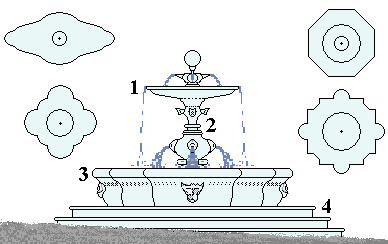 typical scheme of Della Porta's fountains |
|---|
DOMENICO AND GIOVANNI FONTANA (1543-1607 and 1540-1614)
Domenico was the most outstanding member of a whole family of architects who came from Ticino region, now in Switzerland. Still young, he moved to Rome to work in the villa of cardinal Peretti, before he was elected pope (Sixtus V). Later on he worked on St.Peter's central lantern and naves, replacing Della Porta as a supervisor, together with C.Maderno.
 the no longer existing fountain by G. Fontana |
According to Sixtus V's busy town-planning projects, D.Fontana opened new main streets that cut straight through the old districts; he also moved four ancient obelisks to their new location, and built the new Lateran Palace. The only fountain still standing that was entirely drawn by this architect is that of Moses, i.e. the main outlet of the Aqua Felix aqueduct. Fontana's elder brother Giovanni, instead, is credited for having supervised the making of the Aqua Felix aqueduct and for having cooperated with Flaminio Ponzio for the making of the huge Acqua Paola fountain on the Janiculum hill. He also cooperated with Vasanzio for the fountain by Sisto Bridge. A smaller yet elaborate work entirely by G.Fontana (left), on the same hill, was removed in the 19th century, probably because badly damaged during a battle. |
|---|
Other members of the family who worked in Rome were Carlo (Domenico's nephew, 1638-1714), Francesco (Carlo's son, 1668-1708) and Mauro (Francesco's son, 1701-67). Carlo added a basin to the Acqua Paola fountain, and slightly altered the old one before Santa Maria in Trastevere; he is also often credited for the second fountain in St. Peter's square, although this is controversial, as some reliable scholars maintain that Bernini was the actual maker.
GIOVANNI VASANZIO (JAN VAN SANTEN, or VAN ZANTEN 1550 - 1621)
A Dutch architect, wood-carver and engraver from Utrecht, whose name was Italianized when he came to Rome. Here he studied with Flaminio Ponzio, with whom later on he also cooperated. Although in the early 1600s Paul V appointed him "fountain architect", i.e. the official supervisor of fountain-making in Rome, he is mainly remembered for having built the large one by Sisto Bridge, and for having drawn a few minor ones for the Vatican grounds.
CARLO MADERNO (1556 - 1629)
One more member of the Fontana clan: he was Domenico's nephew. Maderno began his carreer as a stone-mason. When his uncle called him to Rome, he distinguished himself with the making of Santa Susanna's church. Then, once in charge for St.Peter's works together with Domenico Fontana, he built the enormous façade of the basilica.
| He also took part to the making of several among Rome's palaces and mansions, among which the Quirinal Palace and the famous 'harpsichord' for the Borghese family (see The Rioni, Campo Marzio). Furthermore, he is remembered as the author of the first of the two fountains in St.Peter's square, into which he turned the late medieval one previously described in this page. Maderno also built the fountain standing in front of Santa Maria Maggiore's basilica, and the one for piazza Scossacavalli (then moved to the bottom of corso Rinascimento when the square disappeared). Remarkably, also one of Carlo Maderno's nephews was to become a famous architect in Rome, although he only built a small wall fountain in the Vatican: Francesco Castelli, who later on changed his surname into Borromini (1599-1667). |
 the basin of the fountain by Santa Maria Maggiore |
|---|
GIROLAMO RAINALDI (1570 - 1655)
Another dinasty of architects was the Rainaldi family. After having been taught by his own father Adriano, Girolamo came to Rome, where he met both Domenico Fontana and Giacomo Della Porta; their influence was so strong that Rainaldi's architectural schemes mainly remained those of the late Renaissance, despite by the turn of the 17th century Rome's art had already stepped into the age of Baroque.
His most famous building is Palazzo Pamhilj, but among other works he is also remembered for the curious bird cage built for Villa Borghese. His only fountains are the couple of ancient tubs that face Palazzo Farnese.
His son Carlo (1611-1691) initially cooperated with Girolamo in the making of the Palazzo Nuovo, on the Capitolium, then worked alone on the façade of Sant'Andrea della Valle, drew the project for the twin churches of piazza del Popolo, but he did not build any fountain.
 |
GIANLORENZO BERNINI (1598 - 1680) Architect, sculptor, painter, playwright and scene-painter, the real master of Rome's Baroque art. His teacher was his own father Pietro (1562-1629), author of the Barcaccia fountain. After his early works for cardinal Borghese, he became the artist that pope Urban VIII preferred among the many ones active in Rome. For this same pope, Bernini built the famous canopy in St.Peter's. But during his long artistic career he crossed the pontificate of five more popes, particularly distinguishing himself with works of sculpture and architecture. As a fountain-maker, he is credited for masterpieces such as the Triton in piazza Barberini, and the great Fountain of the Rivers in piazza Navona, the square in which he also enlarged a preexisting work by Della Porta. Some claim his authorship for the second fountain in St.Peter's square, but this issue is debated. ← the triton after which the fountain it belongs to is named |
|---|
NICOLA (or NICCOLÒ) SALVI (1697 - 1751)
He was an apprentice of architect Antonio Canevari, and would have remained an obscure personage, had his only masterpiece not become one of Rome's very symbols: the Fountain of Trevi. Enough for his name to enter the hall of fame of the city's most famous fountain-makers.
|
other pages in part III (clickable index)
|
the restless horse of the Trevi Fountain |
|---|
 PART I ANCIENT FOUNTAINS |
 PART II SMALL FOUNTAINS |
|---|
|
|
|---|