 |
  |
  |
|---|
~~~ part 2 ~~~
The northern boundary of the district runs along the top of the Quirinal hill up to the Four Fountains crossing (see Fountains, part III page 9), dividing Monti from Trevi. In Roman times, this was the site of the Baths of Constantine (see There Once Was In Rome.... Immediately north-east of this spot, in the mid 1600s two small but very beautiful churches were built one next to the other, drawn by the masters of Rome's Baroque architecture, Gianlorenzo Bernini and Francesco Borromini, whose well-known rivalry is described in Legendary Rome. The two churches also share the feature of having an oval floor plan.
| Sant'Andrea al Quirinale [9], built between 1658 and 1670, faces the long side of Quirinal Palace (in Trevi district), and stands in place of an earlier church, Sant'Andrea a Montecavallo, built in the 1500s. It is known for its lavish marble works and golden dome; Bernini is remembered sitting in the church for hours, in contemplation of what he considered one of his best projects. It is the third main Jesuit church in Rome, which originally served the novitiate of this order. It had been commissioned by Camillo Pamphilj, a nephew of the late pope Innocent X, who had been appointed a cardinal, but had later resignated the charge to get married (his coat of arms over the entrance bears a crown, rather than a cardinal hat). Here the French playwright Victorien Sardou set the first act of his drama La Tosca, which in its more popular operatic adaptation by Giacomo Puccini was changed into Sant'Andrea della Valle, a church located in Parione district. |
 |
|---|
Only a few metres or yards away from Sant'Andrea's, Borromini built San Carlo alle Quattro Fontane's church [10], on one corner of the famous Four Fountains crossing, where three obelisks can be seen in the distance, standing at the bottom of three of the four streets that come together on this spot.
 the inside of Sant'Andrea's dome |
Due to its rather small size, the Romans nicknamed the church San Carlino, i.e. 'St.Charly'. The surface of the whole building matches in size and in shape the cross-section of one of the pillars that support the huge dome of the basilica of St.Peter in the Vatican. Its curious belltower has a spiral shape, yet not as glamorous as the one that the same architect built for the church of Sant'Ivo alla Sapienza, in Sant'Eustachio district, and now partly hidden by the nearby buildings. Borromini had planned to be buried in San Carlo's crypt; but since he died committing suicide, his remains were refused such privilege, and the chapel which he had designed for this purpose remained empty. |
 the inside of San Carlino's dome |
|---|
| Monti is also particularly rich of medieval features of religious inspiration, most of which are located in the southern part of the district. The most famous one is the Lateran complex [11], by the roman gate Porta Asinaria (see Aurelian's Walls). It includes St.John's basilica, cathedral church of Rome, first built in the 4th century and altered on several occasions up to its present shape (17th-18th century). Pope Gregory XI (1370-78) gave it the title of 'mother of all churches in the world'. During the Middle Ages, for almost 1,000 years all the popes have been crowned here. |
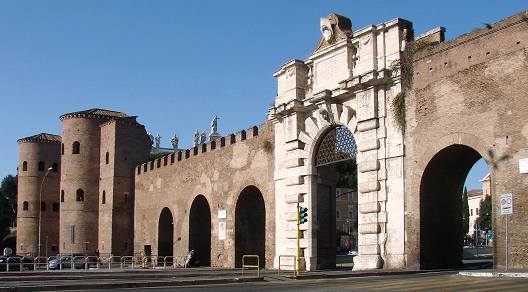 Porta San Giovanni and Porta Asinaria (far left) |
|---|
 |
 |
|---|
| The building next to the church, the Lateran Palace (1586), was built over the
remains of the Patriarchium, a much larger structure where the popes dwelt before their see was moved to Avignon (France) in 1305. Only a few years later, the building was destroyed by a great fire. In fact, when papacy returned back to Rome, the pope's residence was moved to the Vatican. On one side of the present palace stands Rome's tallest Egyptian obelisk (see Obelisks for details), while on the other side of the square a late 16th century building contains the old private chapel of the popes, known as Sancta Sanctorum ("holy among holy places"). It is the only surviving part of the ancient Patriarchium, accessed by a marble staircase called the Holy Steps, wrongly believed to be the original ones from Pontium Pilate's praetorium in Palestine, where Christ faced his trial: for this reason, the faithful climb them on their knees. In the chapel, above the altar, hangs an ancient image which, according to a popular tradition, was painted by a supernatural entity: during the Middle Age, in the case of plagues and other calamities, the popes used to carry it in procession. |
 the Holy Steps |
|---|
 San Clemente's porch |
Not far, midway between the Lateran and the Colosseum, another fascinating complex was built on three different levels: San Clemente [12], also mentioned in Curious and Unusual, page 3. It consists of the Upper Basilica (12th century, featuring beautiful mosaics and frescoes), built on top of a much older church called Lower Basilica (4th century), when the latter, completely below the present ground level, was severely damaged during a raid by the Normans led by Robert Guiscard in 1084. Further deep in the ground are the remains of roman buildings of the late Republican age (2nd-1st century BC), and a mithraeum, a place of worship of god Mithra, of a slightly later (early imperial) period. Also the nearby church called Santi Quattro Coronati belongs to this group of medieval churches, but the rocky cliff on which it was built now belongs to rione Celio, which stretches over the hill that bears the same name. One side of the Coelian Hill, though, belongs to Monti: here stands Santo Stefano Rotondo [13], i.e. 'Round St.Stephen', the first Italian church with a round floor plan, founded in the 5th century. |
|---|
 Santo Stefano Rotondo |
The precincts of this church are actually a stretch of an ancient aqueduct, the so-called Rivus Caelimontani branch described in Aqueducts part III. Originally, Santo Stefano Rotondo had two circular galleries, or naves, and four transepts in the shape of a cross. Due to the bad condition of the old church, in the 1450s three transepts and the
outer gallery had to be demolished. In the surviving gallery, famous frescoes were painted in the first half of the 16th century, featuring brutal and rather gruesome executions of Christian martyrs by Roman emperors. Below the church, some remains of an ancient roman military camp are being dug. |
|---|
| On the Oppius peak the boundaries of three different rioni (namely, Monti, Esquilino and Castro Pretorio) meet in a very large square, in the middle of which stands the basilica of Santa Maria
Maggiore [14] (St.Mary the Major). It is the most ancient and largest among the churches in Rome dedicated to the Virgin Mary; it is also popularly called Liberian Basilica or St.Mary of the Snow, because according to a common belief, pope Liberius had the church built on the spot where a snowfall unexpectedly took place on the 5th of August. Every year, on this date, a popular happening takes place in this square, with an artificial snowfall in memory of the legend. The church was actually founded by Sixtus III soon after the Council of Ephesus (431), in which the status of the Virgin Mary had been defined as 'mother of God'. |
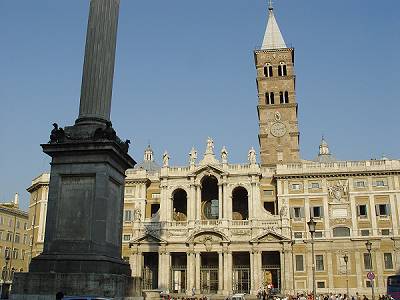 Santa Maria Maggiore |
|---|
 |
Its floor is an original mid 12th century marble work inlaid with geometric patterns (Cosmatesque style). By the end of the following century, the apse and the front of the church were decorated with mosaics. The belltower was built in c.1375, and boasts the record of being the tallest in Rome. The impressive coffered ceiling of the church dates from c.1500; it is said that it was gilded with the first gold that Columbus brought back from the Americas, which had just been discovered. This may not be entirely fictious, as Columbus' enterprise was sponsored by the Spanish king Ferdinand IV, and by the time the ceiling was made, the ruling pope Alexander VI was a Spaniard too. |
 |
|---|
On both sides of the basilica, very lavish chapels were built by Sixtus V (late 1500s), and then by Paul V (early 1600s): their size is so large that they could almost stand as small individual churches.
In the mid 1700s a Baroque porch with a balcony was added to the front of the church, replacing the smaller medieval one, in order to protect the mosaics of the upper part of the façade (late 13th century), yet leaving them partly visible from below.
 (above) the 13th century mosaics on the façade; (centre) a detail of the 5th century pattern also in mosaic, that runs above the nave (right) the column from the Basilica of Maxentius |
Santa Maria Maggiore is famous for its mosaics. The panels above the nave and the ones that cover the triumphal arch date back to the 5th century: they are the earliest mosaics known featuring religious subjects. Instead the large ones of the apse and the aforesaid ones on the façade are late 13th century works. Beside the main altar lies the sober tomb of Gianlorenzo Bernini, the master of Rome's age of Baroque, who took his first steps in his father's workshop, located in a building on the left side of the basilica, remembered by a plaque.  |
 |
|---|
| The column standing in front of the church is the only surviving one from the Basilica of Maxentius (or Basilica of Constantine), therefore it comes from the Roman Forum; pope Paul V had it moved here in 1613. At the back of the church, instead, stands one of Rome's ancient obelisks (see Obelisks, part II for details), originally standing by the entrance of the great tomb of emperor Octavian Augustus (see Campo Marzio district), and then moved here by Sixtus V in 1587. |
 Santa Prassede: the ceiling mosaic in San Zeno's chapel (9th century) |
Another very ancient church in the surroundings, smaller that the aforesaid basilica, is Santa Pudenziana [15], which stands considerably below the modern ground level; its entrance is now reached by a double staircase. Its present shape dates to 1590, but it was first built around the 4th century (late imperial age): a mosaic from the original building, one of the earliest examples based on a Christian theme, decorates the apse; interestingly, the personages it features still wear togae, in the fashion of ancient Rome, and the background depicts a lively view of what the city might have looked like sixteen centuries ago. |
 detail of the late 4th century mosaic in Santa Pudenziana: the senator-like apostles and the Roman buildings in the background |
|---|
| Other fine mosaics of the age of Charlemagne (9th century) can be seen in the nearby church of Santa Prassede [16], now almost hidden in a dark and narrow street: the vault of the small chapel of San Zeno is completely covered with them. The very heart of the district was once almost entirely occupied by the fabulous mansion that emperor Nero had built for himself after most parts of Rome had been destroyed by the great fire of year AD 64. Known as the Domus Aurea [17], or Golden House, it stretched from the Oppius peak down to the southern end of the Roman Forum and one side of the Caelian Hill; it is estimated that it covered over 20% of the city enclosed within the Servian walls. Is many halls and corridors were beautifully decorated with wall paintings, while its gardens spanned over four different districts of the ancient city, and included among their wonders an artificial lake and a gigantic bronze statue, 30 meters (100 feet) in height, featuring the same emperor, portrayed in the attitude of a god; originally the colossus was located on the Velia hill, but later on Hadrian had it moved next to the famous amphiteatre. |
 the extension of the Domus Aurea is shown in red |
|---|
 |
 (← left and above ↑) Nero's Golden House: one of the many corridors that once linked the hundreds of chambers and courtyards, and traces of painting still extant on the wall of a hall |
Immediately after Nero's death, due to his ill-fame, all his memories were destroyed: the ruins of his mansion were filled up and covered with earth, and emperor Trajan built public baths on the new grounds; scanty remains of these baths are visible today in the public park that covers the top of the Oppium Hill, although their huge dimensions still give us an idea of how grand the ancient establishment may have been. |
|---|
| Also the lake was drained and filled up, providing a wide flat area where Rome's largest and most famous ancient public building was then raised: the Flavian Anfitheatre, better known as the Colosseum. When in the early 16th century the ruins of the Golden House were found, many Renaissance artists, including Raphael, used to reach the underground halls, which they called 'grottoes', lowering themselves with ropes (and often leaving on the ceilings their names and other graffiti). The stunning wall paintings that they witnessed, whose colours had been largely preserved in spite their age thanks to the airproof underground environment, greatly influenced the style of wall and ceiling decoration throughout the Renaissance. |  the Golden House: graffiti left in the 1500s on a ceiling |
|---|
 remains of the Baths of Trajan, built over the Golden House |
Unfortunately, those ancient frescoes are now barely visible; once exposed again to the atmosphere after their discovery, and subject to water infiltrations due to their underground location, they soon started to fade, and today appear rather deteriorated. After the making of the Flavian Anfitheatre, emperor Domitian had the Ludus Magnus [18] built nearby, the largest among the gladiator schools. It had the same shape as the major building, so the fighters had the feeling of being in an arena, but its size was obviously much smaller. |
|---|
It was linked to the Colosseum by means of an underground gallery, still extant. Today what remains of the Ludus Magnus is merely half of the floor plan of the original building, but the oval outline of the arena is still clearly distinguishable. |
|
|---|


 |
|
|
|---|